


The life and death of Richmond Soccer Club

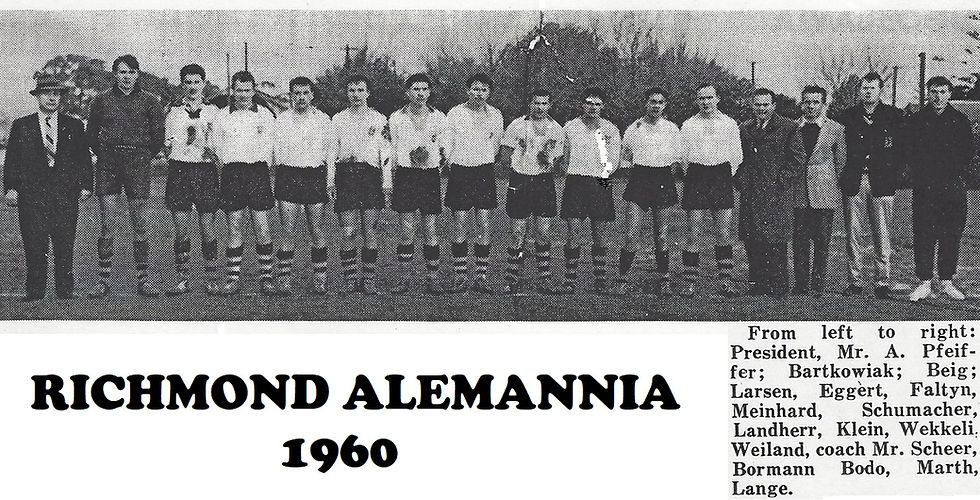
It is probably time someone spoke about Richmond. The sad reality is that many readers will be asking themselves whether I am writing about an AFL club, not knowing the storied Melbourne side that once competed at the top of the Victorian football pyramid.
It was a slow and ignominious death for Richmond Soccer Club: one day they were competing in the NPL Victoria, and the next they had quietly disappeared from the fixtures, without so much as a ceremonial farewell. Front Page Football, with valued input from Victorian football historian and former Richmond administrator Mark Borić, dive into the history of Richmond SC and explain its legacy today.
The origins of Richmond are believed to lie in the Maribyrnong Migrant Hostel, which operated from 1950 until 1987. In 1953, a German-backed club named Maribyrnong appeared in the Victorian Amateur Soccer Football Association’s fourth division, winning promotion to the third division in their first season. From 1955, Maribyrnong became associated with the Tivoli Club in Richmond, a German cultural organisation.
The football club relocated to Survey Park (now Burnley Park) to be closer to its patrons and was subsequently rechristened Alemannia Richmond (often shortened to Richmond). Richmond had brief stints in the top tier of Victorian football in 1961 and 1963, but spent the rest of the 20th century bouncing between the second and third tiers.
By the 1970s, the German element at Alemannia had already begun to wane due to a parallel trend within the broader community toward assimilation. It was at this point Richmond began to develop a more multicultural character, with notable input from Melbourne’s Greek community in particular.
Richmond began building steam in the 1990s under renowned president and benefactor Helmut Kalitzki, coming into its own during the A-League era, when the club finally solidified its place in the first tier of Victorian football – the Victorian Premier League (VPL).
Now known as Richmond Eagles, the storied side competed in the VPL for seven seasons straight. In that time, a small collection of Melbourne Victory fans attached themselves to the club during the A-League off-season, styling themselves as the “Heyington Bridge Crew” (after the rail bridge nearby the ground). Some fiery fixtures against Whittlesea Zebras and South Melbourne in 2007 contributed to the end of that short-lived association.
READ MORE ON FPF
MELBOURNE KNIGHTS: Unchartered waters: A relegated Melbourne Knights
Most of Richmond’s time in the VPL was fairly lacklustre, barring the 2010 season in which the Eagles secured the premiership and progressed to the final against Green Gully, losing 3-0 in the end. This would be Richmond’s only top-tier silverware in its history, and the only time the club qualified for a final.
2013 was the last year in Victoria for the old VPL structure before the switch to NPL. Richmond were relegated that season, though strong performances in the new (confusingly) second-tier NPL 1 in 2014 and 2015 saw the Eagles compete in NPL Victoria in 2016. Unfortunately, it would be the last hoorah for the storied side. Richmond finished 12th out of 14 teams, forcing them into a promotion/relegation playoff with North Geelong Warriors. Alemannia were steamrolled 0-4 by the Croatian heritage club.
Dropping down to NPL 2 East for 2017, Richmond were immediately relegated out of Victoria’s semi-professional environment, finishing dead last on the table. By this point, the club was already facing financial troubles due to tax debt and lost sponsorships. Things were only about to get worse.
Strong signings in 2018 meant Richmond SC were in the running for the Victorian State League (VSL) Division 1 South-East title, which would have secured them promotion back into NPL 2. This honour was instead secured by Manningham United Blues, who finished the season four points above Richmond and were subsequently promoted instead of the Eagles.
Richmond failed to win promotion again the following season, provoking a club crisis. By this point, the club’s financial situation was dire and a merger was sought to avoid collapse. This is where Fitzroy City (historically Fitzroy Serbia) enters the story.
In 2019, Fitzroy City had just won the VSL Division 2 North-West, securing promotion to Division 1 North-West for 2020. Seeking better facilities for their club and to revive the golden era of their time in the old VPL, negotiations began between Fitzroy and Richmond for a merger. The saga that spawned from this critical juncture was one of the most controversial in modern Victorian football.
It must be stressed that factual information on the merger negotiations between Fitzroy City and Richmond is limited. The negotiations became mired in dispute and personal conflict. Front Page Football does not claim to present a totally accurate account of the proceedings that took place, and all information provided is existing public knowledge.
Notwithstanding, an Extraordinary General Meeting (EGM) was called by Richmond following the conclusion of the 2019 season to discuss the potential merger with Fitzroy. In the lead-up, Fitzroy people were allegedly signed up as Richmond members to bolster support for the merger. The EGM failed to reach a consensus on the issue as it descended into a bout of intimidation and harassment. Many of the existing Richmond members and the parents of the club’s junior players were alleged to have vigorously opposed the merger.
A second EGM was organised with hired security to prevent a repeat of the first session. Football Victoria eventually intervened, ruling that the respective clubs field separate teams for the upcoming 2020 season. That season never went ahead, and when football returned in 2021, Fitzroy City were playing out of Kevin Bartlett Reserve (Richmond’s home for decades), while Richmond were playing at the Serbian Sports Centre, 35 kilometres away.

Richmond Soccer Club effectively died after those EGMs in 2019. By the time the club (in name only) returned to the pitch in 2021, it was a completely different entity playing nowhere near its traditional base; having instead been adopted by the local Afghan community.
In 2023, this new “Richmond” secured its own facilities at Fotheringham Reserve in Dandenong, and the following season it finally rebranded to Greater Dandenong FC. This successor club, while acknowledging its previous history, lists its own foundation date as 2021, not 1953. Greater Dandenong currently competes in VSL Division 4 South-East.
As for Fitzroy City, the club officially changed its name to Melbourne Srbija in 2023 and now plays in VPL 1, Victoria’s second tier competition.
With the painful and anonymous demise of Richmond Alemannia, so too died the last of the German heritage football clubs in Victoria. It is a club that gave a lot to the Victorian footballing community over the decades, and certainly deserved a more fitting end than what it received. Possibly, there is a lesson to be learned from Richmond’s downfall on how not to handle a merger for a struggling side.
There is probably also some commentary on multiculturalism that could be made about a club that was established by German migrants, eventually became populated with Greeks, was nearly taken over by Serbians, before finally being sunsetted by Afghans. That is the beautiful game though, and Richmond has joined the pantheon of the past greats of Victorian football: J.U.S.T, Slavia, Hungaria – Alemannia.
R.I.P Richmond, 1953-2019.
This article could not have been written without the contribution of Mark Borić, a former administrator at Richmond from 2001 to 2013.
Mark is working on a history of the club at https://richmondalemanniahistory.blogspot.com/ and also writes the established Melbourne Soccer blog at https://melbournesoccer.blogspot.com/


Isn't Keilor still around? They were formed by Austrian immigrants, but they are still Germanic, no?
Great Club was Richmond! But destroyed by FFV ruling in my opinion. Hopefully all the people that run the Club, like Helmet found a new club?